A copied carton can look convincing from across a shop counter. The real test comes when a distributor, retailer or customer looks closer – at the seal, the finish, the evidence that the pack has not been opened, and the detail a counterfeiter did not expect. That is why anti-counterfeiting packaging trends are moving beyond one visible mark towards security that is harder to copy, easier to check and properly matched to the product risk.
For UK brands, this is not simply a packaging design decision. Counterfeit goods can create warranty claims, safety concerns, compliance problems and a lasting loss of confidence in the genuine product. Packaging is often the first point at which a suspicious item can be identified, so it needs to work in the real world: in warehouses, on retail shelves, during delivery and in a customer’s hands.
Why anti-counterfeiting packaging trends are changing
Counterfeiters have better access to commercial printing, digital artwork and global distribution routes than they once did. A basic sticker, standard foil effect or easy-to-copy QR code may still add a small obstacle, but it is rarely enough on its own for products that attract serious imitation or diversion.
At the same time, brands are under pressure to simplify their packs, reduce material use and keep production costs under control. The answer is not automatically the most complex label available. It is a layered approach where the right combination of visible features, concealed checks and tamper evidence reflects the value of the product and the likely threat.
This change also reflects who needs to authenticate a product. A shopper needs a quick visual cue. A retailer may need a clear way to reject a suspect delivery. A brand protection team may need a feature that is not publicly described. Each audience needs a different level of reassurance, which is why one-dimensional packaging security is giving way to labels that perform several jobs at once.
Layered holograms are replacing single-feature labels
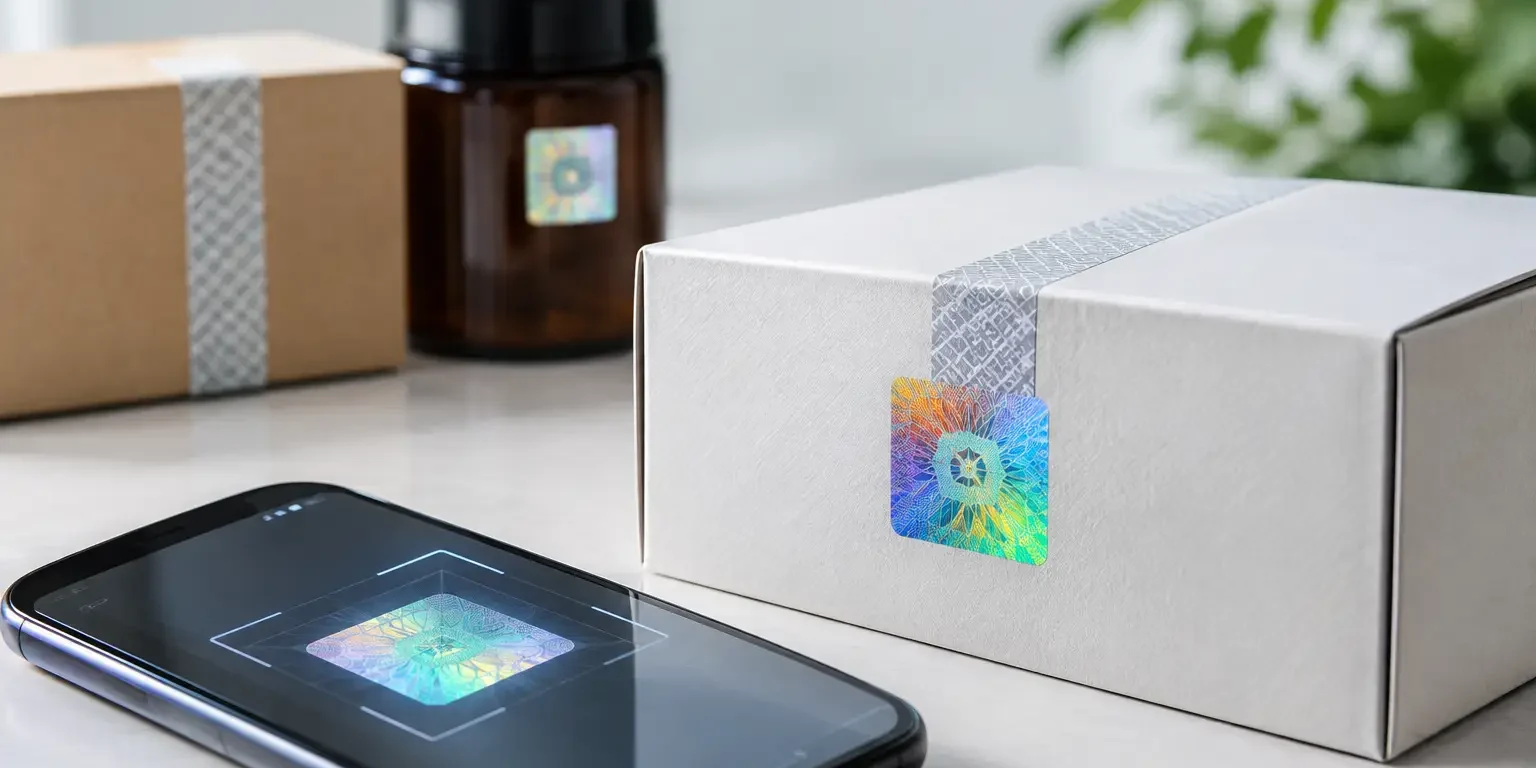
Holographic labels remain one of the most recognisable product-authentication tools because their changing light effect is difficult to reproduce well with ordinary printing. The stronger trend is towards bespoke holograms that bring several security devices into one label rather than relying on a generic holographic pattern.
A company logo, repeating brand pattern or custom image can be incorporated into the hologram itself. That makes the label more distinctive and gives customers a familiar visual reference point. It also makes substitution with a stock label less convincing.
The most effective designs pair that visible holographic effect with details intended for closer inspection. Hidden text or images, UV-reactive features, micro-detail and elements that react to heat or a coin can give authorised staff practical ways to check a label without putting every security instruction in public view. The purpose is not to make authentication complicated. It is to ensure a counterfeiter must overcome more than one barrier.
There is a trade-off. Adding features that no one in the supply chain knows how to inspect does not deliver much value. Before choosing a design, decide who will check it, what they will use and what they should do when something does not look right. A simple visible feature, supported by one or two controlled checks, is often more useful than an overcrowded label.
Tamper evidence is becoming part of brand protection
Authentication confirms that a label or product appears genuine. Tamper evidence answers a different question: has this pack been opened, refilled or interfered with since leaving an authorised source? For medicines, cosmetics, electronics, spirits and high-value components, both questions matter.
Destructible materials break apart when removal is attempted. Void labels leave a visible message on the item or seal after lifting. Honeycomb constructions fragment in a way that makes reapplication difficult. These materials turn opening into visible evidence, which is particularly valuable where a counterfeiter may try to reuse genuine packaging or replace the product inside it.
The best material depends on the surface and journey. A label on a smooth carton has different requirements from a seal on a textured plastic bottle, metal casing or curved component. Temperature, moisture, oils and abrasion all affect performance. Testing on the actual pack should happen before a full production run, especially if the product travels through cold storage, export routes or demanding industrial conditions.
Tamper evidence should also be designed into the customer experience. A seal that is difficult to remove cleanly may be appropriate for a warranty label, but frustrating on a consumer pack that must be opened quickly. Good security packaging makes interference obvious without making genuine use unnecessarily awkward.
Digital checks need a physical partner
QR codes and digital product pages are increasingly used to give customers more information, record engagement or direct them to an authentication journey. They can be useful, but a QR code by itself is not a security feature. It can be copied as easily as any other printed graphic unless it is tied to controlled, unique data and a suitable verification process.
This is where physical and digital measures work best together. A bespoke hologram or tamper-evident seal gives immediate physical evidence, while variable serial numbers, barcodes or unique codes can provide traceability and more detailed investigation. The physical label makes casual copying harder. The variable data can help identify duplicated numbers, unexpected scan patterns or stock appearing outside approved channels.
Not every business needs serialisation. For a lower-value product with a local distribution network, a custom tamper-evident hologram may be the sensible starting point. For regulated goods, premium collectibles or products exposed to grey-market diversion, unique identifiers may justify the additional process. HologramLabel.co.uk can support bespoke holographic and tamper-evident labels, while requirements for variable data, barcodes, serial numbers and custom text can be handled through its specialist partner service.
Packaging security is becoming more brand-led
Security labels used to be treated as an awkward add-on applied late in the packaging process. More brands now use them as a visible part of their presentation. A hologram can carry a logo, selected colours and a tailored pattern while still delivering authentication and tamper evidence.
That matters because customers are more likely to notice and trust a feature that feels integral to the product. A well-designed seal can reinforce premium positioning, tell buyers where to look for authenticity and make the genuine pack harder to imitate without making it look overly technical.
However, discretion has value. If every security detail is visible and explained on-pack, counterfeiters receive a useful blueprint. A balanced design normally combines an overt feature for public recognition with covert elements known only to the brand and its approved checkers. This gives sales teams and customers a clear cue while retaining a level of controlled verification.
Sustainability decisions require practical judgement
Pressure to reduce packaging waste is shaping label choices, but sustainability and security must be assessed together rather than treated as opposing goals. A label that is easy to remove may suit a recycling objective but offer little protection against re-use. A highly destructive material may provide strong tamper evidence but require consideration within the wider pack material strategy.
The useful question is not whether a security label is perfectly recyclable in isolation. It is whether the full packaging solution protects the product, supports the intended disposal route and avoids unnecessary material. Reducing label size, choosing an appropriate construction and avoiding needless layers can all help, provided the label remains clear and fit for purpose.
For high-risk products, preventing counterfeit or unsafe goods from entering the market is itself a material consideration. Replacements, recalls and damaged stock all carry an environmental cost as well as a commercial one.
Build security around the real point of failure
The strongest anti-counterfeiting packaging trends are practical rather than theatrical. They focus on the point where your product is most vulnerable: a seal that can be lifted, a carton that can be copied, a component that can be substituted, or stock that can be diverted into an unauthorised channel.
Start with that risk, then select features that create a clear inspection routine. Consider what a customer can see, what a retailer can check, what your team can verify and what evidence remains if the pack has been interfered with. Include procurement, operations and brand teams early, because a label that looks excellent but cannot be applied reliably at speed will cause avoidable problems.
A low minimum order quantity makes it possible to test a bespoke solution before committing to a larger rollout. Bring forward the pack material, product surface, application method and the outcome you need from the label. With the right questions answered at the start, advanced security need not be complicated or overpriced. It can become one of the clearest signals that your brand takes the genuine product – and the people buying it – seriously.