A security label has to work in the real world, not just look impressive on a proof. It may be applied to a small cosmetics carton, an electronic component, a spirits bottle or industrial equipment, then handled by distributors, retailers and customers. A well-planned custom hologram design guide starts with that journey: what needs protecting, who needs to verify it and what should happen if someone tries to remove or copy the label.
For many UK businesses, a bespoke hologram is one of the most visible and practical ways to reinforce product authenticity. It can carry your brand identity while adding layers of protection that are difficult to reproduce with ordinary print. The right design also gives customers a quick, reassuring sign that the product in front of them is genuine.
Start with the risk, not the artwork
Hologram labels can address several commercial problems, but they should not all be designed in the same way. A premium skincare brand concerned about convincing counterfeits needs a different approach from a manufacturer trying to show that a warranty seal has not been disturbed.
Begin by identifying the point of greatest risk. Is it counterfeit stock entering retail channels? Unauthorised opening during transport? Product diversion into an unintended market? Or is your main objective to make branded packaging more distinctive while giving buyers a simple authenticity cue?
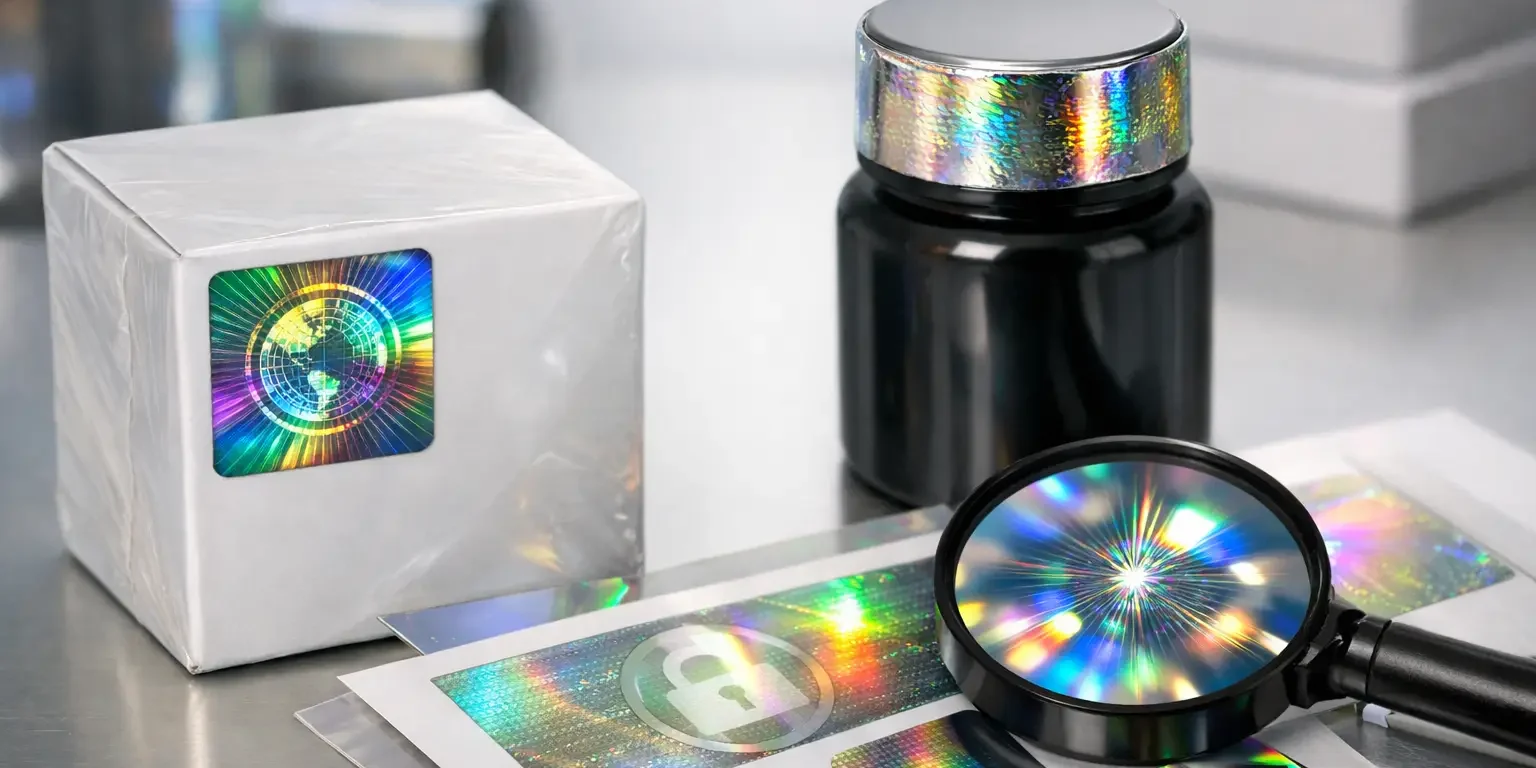
This decision shapes the balance between overt, covert and tamper-evident features. Overt features are visible without tools, such as a colour-shifting holographic image, a detailed pattern or your logo. They help retailers and customers make a quick visual check. Covert features, including UV elements, hidden text or concealed images, give trained staff a second level of verification. Tamper evidence shows whether the label has been lifted, broken or interfered with.
There is no benefit in specifying every available feature simply because it is available. More complexity can increase cost and may make verification harder for the people expected to use it. The best solution is proportionate to the product value, the likely threat and the checking process you can realistically support.
Build the hologram around your brand
A custom hologram should feel like part of your packaging, not an afterthought applied at the end of the line. Your logo, brand name, symbols and selected visual motifs can be incorporated into the holographic master design. This makes the label recognisable to customers and more difficult for counterfeiters to imitate convincingly.
Keep the key brand elements clear. Fine detail can look striking in a hologram, but excessively small lettering or a crowded layout may be difficult to read at the point of sale. A strong design usually has one obvious authentication feature, such as a prominent logo or distinctive image, supported by smaller detail that becomes visible as the label moves under light.
Colour also needs careful thought. Holographic foil naturally changes appearance as viewing angles change, so brand colours may not reproduce in the same flat way as conventional ink. This is often a strength rather than a limitation. Use the holographic effect to create contrast and movement, while keeping essential text and brand recognition straightforward.
Shape matters too. A standard round, rectangular or square label may offer the most efficient application, but a bespoke outline can make the product stand out and make substitution more obvious. The trade-off is practical: intricate shapes can be less economical and may not suit every application method. Consider the available space, the surface curve and whether labels are applied by hand or machine before finalising the format.
Choose a material that supports the job
The surface beneath the label is as important as the artwork. Glass, coated card, plastic, metal and textured packaging all behave differently. A label applied to a smooth carton may only need visual authentication, whereas a seal across a carton opening or bottle closure needs an adhesive and face material that reveals interference.
Destructible materials break apart when removal is attempted. Void materials leave a visible message or pattern behind, while honeycomb structures provide a clear indication that the seal has been disturbed. These options can turn a hologram into a packaging-integrity device rather than a decorative sticker.
Tamper evidence is particularly useful where a label bridges two surfaces, such as a box lid and base, or sits over a cap. However, it depends on proper placement. A seal positioned where it can be cut around, peeled cleanly or covered by another label will provide less protection. Test it on the final pack, including any coatings, curves and cold-storage conditions that may affect adhesion.
Add security features people can actually verify
The most effective designs use layers. A consumer may check one visible feature in seconds, while a retailer, distributor or internal quality team can carry out a more detailed check when required. Each layer should have a clear purpose and a defined audience.
For visible authentication, a bespoke holographic image, repeating micro-pattern, logo treatment or optical movement can create a recognisable signature. These features make casual copying harder because a standard metallic sticker cannot replicate the same effect.
For controlled checks, UV-reactive print or hidden wording can be revealed with a simple UV light. Concealed images and text provide another verification route without advertising every security measure on the label itself. Thermo-reactive and coin-reactive elements can introduce an interactive test, although they should only be used where staff understand what they are checking for and where the test will not disrupt normal handling.
Scratch-off areas can be useful when information should remain hidden until a particular stage, such as a promotional reveal or controlled inspection. They are not automatically a substitute for serialisation, though. If every label needs a unique number, barcode, variable text or asset identifier, this should be planned as part of the wider label programme. HologramLabel.co.uk can help develop the bespoke holographic security element, while Security-Label.co.uk supports projects requiring variable data, barcodes and serial numbering.
Make application part of the design process
A label that is difficult to apply consistently can create gaps in protection. Before production, confirm where the hologram will sit, how it will be applied and what happens to it throughout packing, storage and distribution.
Hand application offers flexibility for short runs and awkward pack shapes, but requires clear positioning guidance so every label is placed in the same location. Machine application supports higher volumes and repeatability, yet label size, roll direction, spacing and release liner all need to suit the equipment. Discuss these details early rather than treating them as production administration.
Environmental conditions matter as well. Labels may encounter humidity, refrigeration, oils, dust or abrasion. A label on an indoor retail box faces a different set of demands from one used on an automotive part or industrial component. Samples applied to real packaging are invaluable because they reveal issues that a digital proof cannot: edge lift, poor adhesion, difficult release or an effect that is less visible under shop lighting.
Review the design through an adversary’s eyes
Before approving a final design, ask a simple question: if somebody wanted to pass off a fake as genuine, what would they copy first? Usually, it is the most obvious visual cue. Make that cue distinctive enough that a cheap imitation is noticeable, then provide extra features for closer inspection.
Also consider how a genuine label could be removed and reused. If reuse is a realistic risk, tamper-evident construction should be central to the specification. If the product is high value or heavily targeted, combine a visible branded hologram with covert verification rather than relying on appearance alone.
A good supplier will turn these questions into a practical design brief, explaining the choices in plain English and showing what is achievable for your order volume and budget. Low minimum quantities make it possible to introduce a bespoke solution before a brand reaches very large production runs, while still leaving room to develop the specification as risks change.
A clear brief saves time and protects value
When requesting a custom hologram, provide your logo or artwork in the best available format, the label dimensions or available area, the packaging material and how the label will be applied. Explain the security concern, the number of labels required and whether the label must show tampering. If you already have a packaging design, share the intended placement so the hologram can complement it rather than compete with essential product information.
You do not need to arrive with a finished technical specification. Bring the commercial problem, the product and your brand ideas. The right hologram design can then turn those requirements into a visible mark of quality, a harder target for counterfeiters and a seal that gives customers more reason to trust what they buy.