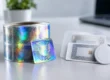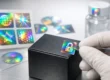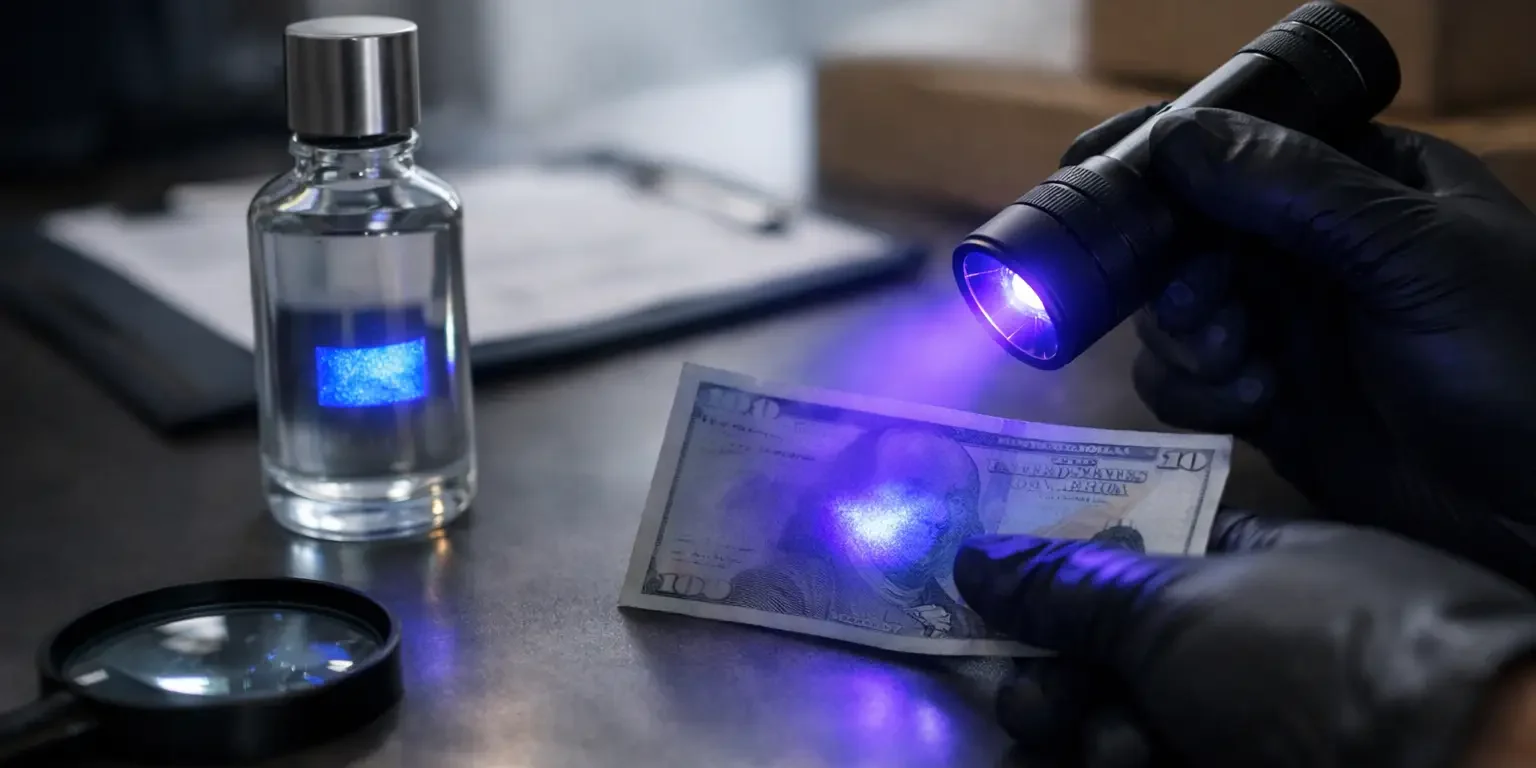
A counterfeit label can look convincing under warehouse lighting, on a shop shelf and even in a product photograph. Invisible UV security labels give authorised staff a fast extra check that copyists cannot easily anticipate or reproduce. Under the correct UV light, a hidden mark, pattern or message appears – providing practical evidence that a product, pack or seal has come through the intended supply chain.
For brands dealing with high-value goods, safety-critical parts or products vulnerable to diversion, that small check can protect much more than packaging. It helps safeguard customer confidence, retailer relationships and the reputation built around the product itself.
What invisible UV security labels do
An invisible UV feature uses specially selected inks or coatings that are difficult or impossible to see in normal light. When exposed to ultraviolet light, the feature fluoresces, revealing a chosen design. This might be a logo, hidden text, a serial-style pattern, a symbol, a border or an image incorporated into a holographic label.
The value lies in discretion. A visible hologram provides an immediate first line of defence because customers and inspectors can recognise it without equipment. A UV feature sits behind that visible check. It is intended for trained teams, distributors, retailers, warranty departments or investigators who need a more reliable way to distinguish a genuine label from a lookalike.
That does not mean UV is a magic answer on its own. A basic fluorescent mark can be imitated by a determined counterfeiter with access to the right materials. The strongest approach combines UV authentication with a distinctive holographic design and, where appropriate, tamper-evident construction. Security works best in layers because each layer raises the effort, knowledge and cost required to create a convincing fake.
Where invisible UV security labels make commercial sense
UV features are particularly useful where products pass through several hands before reaching the end user. A distributor can check incoming stock quickly. A field engineer can inspect replacement parts. A retailer can investigate a suspicious return without opening the product. The authentication process remains controlled, rather than advertising every security detail on the outside of the pack.
They are commonly considered for pharmaceuticals and supplements, electronics, automotive components, cosmetics, alcohol, collectibles and branded consumer goods. The precise need varies. On a cosmetic carton, the concern may be counterfeit stock entering online marketplaces. On an automotive part, it may be unapproved substitution. For a limited-edition collectible, authentication may support resale confidence as well as original sales.
The best location depends on what needs protecting. A label across a carton closure can show both authenticity and whether the pack has been opened. A label on the product itself stays with the item if outer packaging is discarded. For reusable equipment or larger assets, the label needs a material and adhesive suited to the surface, expected handling and operating environment.
Authentication and tamper evidence solve different problems
Authentication answers the question: is this label likely to be genuine? Tamper evidence answers: has this pack or item been opened, removed or interfered with? Both are valuable, but they should not be confused.
A destructible label breaks apart when someone tries to remove it. A void or honeycomb label leaves a visible message or pattern behind. These materials can make label transfer difficult, while a UV feature gives the remaining label a covert verification point. Combining the two is often more useful than adding a UV mark to an ordinary removable sticker.
There are trade-offs. Some applications need a clean-looking premium finish and only light tamper resistance. Others need obvious evidence of opening, even if the label cannot be removed neatly. The right choice comes from the risk, the product surface and how the product is handled after sale.
How to specify a UV label that is harder to copy
The starting point is not simply asking for “UV ink”. It is deciding who will inspect the label, what they need to see and what a genuine result should look like. If the feature is too subtle, legitimate users may struggle to verify it. If it is overly obvious or described publicly, it gives counterfeiters useful information.
A practical design can include a UV logo within the holographic artwork, a hidden word repeated in a border, or a small symbol placed in a known area. The mark should be distinctive enough for trained users to recognise quickly, but not so complicated that it is difficult to check in real working conditions.
Consider these questions before approving artwork:
- Which people will carry out the check, and will they have access to a suitable UV torch or inspection point?
- Is the label checked at goods-in, during production, in the field, at retail, or only when there is a concern?
- Should the UV response be a single visible colour, or part of a more detailed pattern?
- Does the label also need to reveal tampering, resist removal or survive heat, moisture, oils and abrasion?
- What information must remain confidential to keep the verification process effective?
The last point matters. A security feature is not strengthened by publishing every detail in product literature. Internal guidance should tell authorised teams where to look, what light to use and what they should expect to see. That guidance should also explain what to do if a label fails inspection, so a suspicious item is isolated rather than returned to normal stock by mistake.
Use design complexity with purpose
It is tempting to add every available security feature. Sometimes that is justified, particularly for goods with a high counterfeit risk or serious safety implications. In other cases, unnecessary complexity increases cost without improving the actual checking process.
A good label design usually has a clear overt feature, a covert UV check and a physical response to removal where needed. Additional elements such as hidden text, coin-reactive effects, thermo-reactive areas or scratch-off sections can be added where they support a real use case. The aim is not technical theatre. It is a label that is difficult to copy and straightforward for the right people to authenticate.
Build the checking process around the label
A UV feature only protects the business when someone uses it. That means supplying the right inspection light, training relevant staff and making the check part of an existing process. Goods-in teams may inspect a sample from every delivery. Quality teams may check labels during packing. Customer service teams may use UV verification when handling warranty claims or suspected counterfeit reports.
Keep the process simple. Staff should know the correct viewing distance, the expected fluorescent design and the action to take if the response is absent, weak or in the wrong place. A quick reference card held at an inspection station can be more effective than a lengthy procedure that no one consults.
It is also wise to test labels on real packaging before committing to a full run. Gloss, metallic foils, coloured cartons and curved containers can affect what an inspector sees. Test under normal warehouse conditions rather than only at a desk. Confirm that the UV feature is clear, the hologram remains attractive, and the adhesive or tamper material performs as expected.
Avoid common weaknesses
The most common mistake is relying on one feature alone. A label that only fluoresces may deter casual copying, but it gives limited protection against organised counterfeiters. Another weakness is placing a hidden mark where it becomes difficult to view once the product is packed, shelved or installed.
Poor process control can undermine even an excellent design. If labels are applied inconsistently, genuine labels may appear in the wrong position. If unused labels are not accounted for, they can be lost or misused. If distributors do not know how to check them, the covert feature becomes an unused cost.
Think about lifecycle too. A label on a bottle may only need to perform until purchase. A label on industrial equipment may need to remain readable for years. Adhesive choice, material durability and exposure to cleaning products, sunlight or temperature changes should be discussed at the design stage.
A practical brief for bespoke UV labels
When requesting a bespoke solution, provide a clear description of the product, packaging surface, application method, expected environment and the type of threat you are trying to reduce. Share the brand artwork and explain whether the label must include a visible logo, hidden UV element, tamper evidence or several layers together.
It also helps to state the likely order quantity and deadline. Low minimum order quantities can make it easier to test a design or protect a specialist product line before scaling up. A supplier should be able to turn security requirements into a practical label specification without forcing your team to become materials experts – that is their job.
HologramLabel.co.uk can help businesses combine holographic design, UV features and tamper-evident materials into labels that suit the product, the risk and the budget. Bring the concern, the packaging and the ambition; a well-designed authentication label gives your team a clear way to prove what belongs in the supply chain.