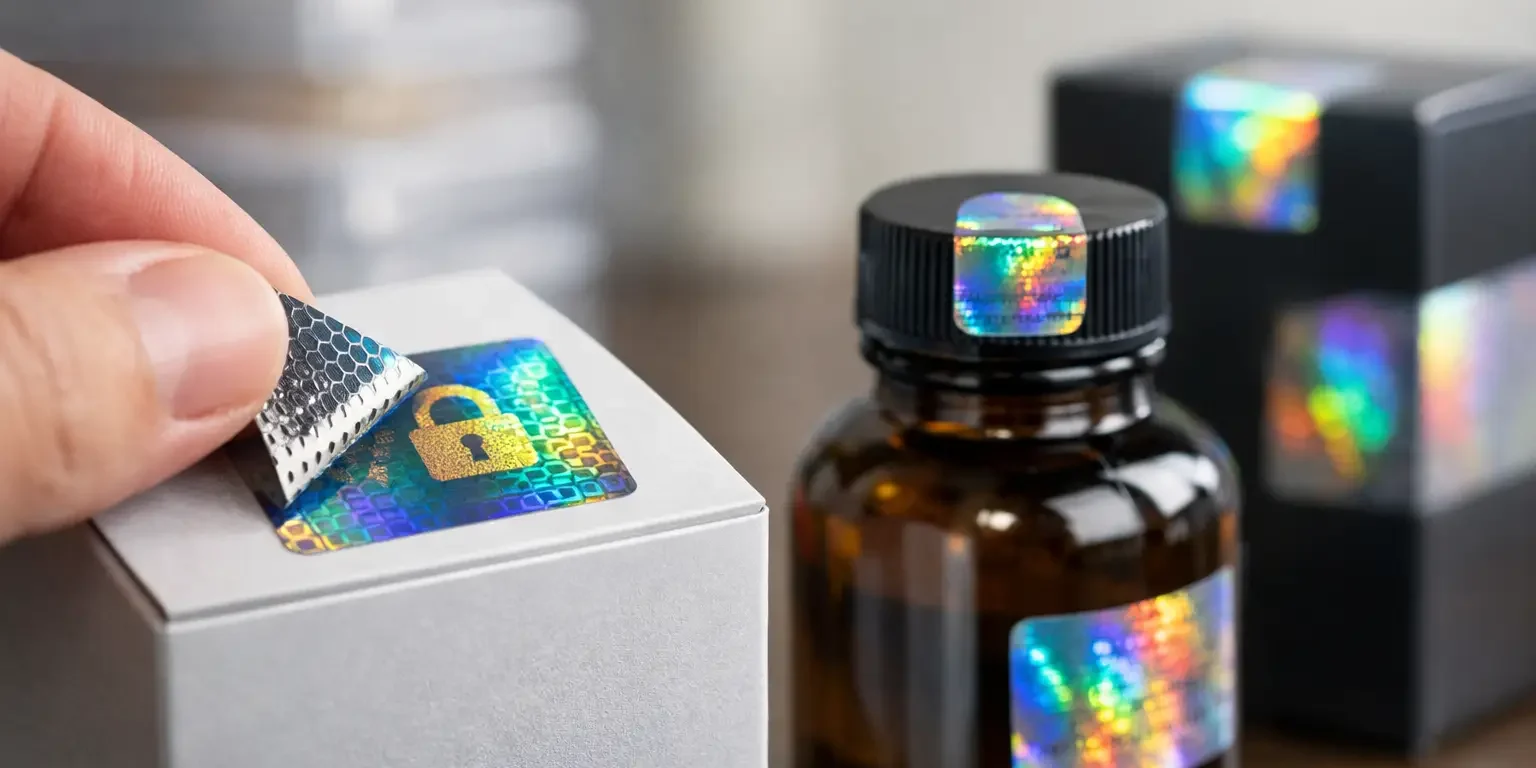
A customer should be able to tell, in seconds, whether a product looks right, unopened and genuinely yours. Holographic security seals give them that visible reassurance while creating a far more difficult target for counterfeiters, grey-market sellers and anyone tempted to interfere with packaging.
For UK product brands, the value is not simply a shiny label. A well-specified seal can combine distinctive brand presentation, overt authentication and tamper evidence in one compact component. It helps protect revenue and reputation at the point where both are most exposed: when the product changes hands.
What holographic security seals actually do
A holographic seal uses a light-responsive image or pattern that changes appearance as it is tilted. This effect is difficult to copy convincingly with ordinary printing or a basic metallic sticker. It gives staff, distributors and customers an immediate visual cue that the item has passed through the intended supply chain.
The strongest designs do more than look impressive. They make the seal part of the pack’s integrity. Applied across a carton flap, bottle closure, electronics housing or protective case, a tamper-evident hologram can show clear evidence if somebody has tried to open, swap or refill the product.
That distinction matters. Authentication answers, “Is this likely to be genuine?” Tamper evidence answers, “Has this pack been opened or interfered with?” Holographic security seals can address both questions, but the material and application position must be chosen for the job.
A premium cosmetics carton may need a small seal that complements a carefully designed pack. An industrial component might need a tougher label that leaves a visible VOID message on removal. A collectible could benefit from a highly recognisable custom hologram that reassures buyers in a resale market. The right answer depends on the threat, the product surface and how people will inspect it.
Why a generic hologram is rarely enough
Stock hologram labels are a practical, cost-effective option for basic tamper evidence or a quick visual deterrent. They can be especially useful on lower-risk products, short runs, event merchandise and internal packaging. Their limitation is straightforward: if the same design is widely available, it is less useful as proof that an item belongs to your brand.
Bespoke holographic security seals add a layer of ownership. Your logo, wording, pattern or brand motif can be built into the holographic image, making it much harder for a counterfeiter to source a convincing substitute. It also creates a recognisable feature for retailers and customers to check.
The best approach is usually proportional rather than excessive. A high-value pharmaceutical, automotive part or electronic device may justify several overt and covert features. A growing skincare brand may achieve a strong result with a custom logo hologram and a destructible tamper material. Spending should follow the commercial risk, not a race for the most complicated specification.
The security features worth considering
Security works best in layers. A feature that can be seen instantly helps frontline checks. A hidden feature gives you a second level of confirmation when a suspicious product is investigated. Tamper evidence makes interference difficult to hide.
Common options include:
- Custom holographic artwork, such as a logo, repeated brand name, guilloche-style pattern or bespoke image that is hard to replicate accurately.
- UV-reactive elements, visible only under ultraviolet light, for a simple secondary check by trained staff or quality teams.
- Hidden text and images, incorporated into the design for close inspection and controlled authentication.
- Thermo-reactive or coin-reactive features, which change or reveal detail when handled in a specified way.
- Scratch-off areas, useful where a concealed code or verification detail needs to remain protected until use.
- VOID, destructible or honeycomb materials, designed to fracture, leave residue or reveal a message when removal is attempted.
Not every feature suits every pack. UV details are useful only if the people checking products have access to UV light and know what to look for. Scratch-off panels can protect information, but they add an interaction step for the user. Destructible materials give strong tamper indication, yet may not be suitable for a surface that needs to remain perfectly clean after removal.
This is why a short discussion about use, handling and risk is more valuable than selecting features from a catalogue in isolation.
Start with the risk, not the label shape
Before commissioning a seal, identify where the real exposure sits. Is the concern counterfeit goods entering online marketplaces? Is it unauthorised opening in distribution? Are returned products being substituted and sent back into stock? Or is the objective to make a premium product visibly more trustworthy at retail?
The answers shape the specification. If packages are being opened and resealed, the seal should bridge a genuine opening point and use a material that cannot be lifted cleanly. If counterfeits are the primary concern, distinctive custom artwork and an inspection feature may matter more. If diversion is an issue, a broader marking and tracking programme may be needed alongside the hologram.
It is also worth considering who will perform the check. Consumers need an obvious instruction-free cue, such as a recognisable holographic design and an intact seal. Warehouse teams can work with a more detailed check process. Investigators and brand-protection staff may use covert features that are deliberately not advertised.
A seal should never rely on secrecy alone. If customers cannot recognise anything about it, it loses much of its deterrent and reassurance value. Equally, showing every security detail publicly gives counterfeiters a useful brief. The sensible balance is visible brand recognition with controlled secondary features.
Material and application make or break performance
An excellent holographic design can fail if the adhesive or material is wrong for the surface. Cardboard cartons, coated boxes, glass bottles, curved plastic jars, powder-coated metal and textured mouldings all behave differently. Temperature, moisture, oils and abrasion during transport can also affect performance.
Ask where the label will be applied, whether the surface is flat or curved, and what conditions it will face before purchase. A seal applied by hand to a dry carton has different requirements from one applied on a production line to a cold glass bottle. Labels should also be tested on real packaging, ideally through the same filling, packing and distribution process used for sale.
Placement deserves equal attention. Put the seal where removing it is inconvenient and obvious, not merely where there is an empty patch of packaging. On a carton, that often means across the opening flap. On a closure, it may mean bridging the cap and container. Ensure the hologram remains visible, is not obscured by shrink film or a retail label, and can be checked without damaging the product.
Build a check process around the seal
A security seal is most effective when people know what it means. Your customer service, quality, sales and distribution teams should have a simple reference showing the genuine design, the intended placement and the signs of tampering. Keep it practical: an intact seal should look like this; a lifted, broken or mismatched seal should be quarantined and reviewed.
For products sold through distributors or retailers, give relevant partners enough guidance to spot obvious issues. This protects them as well as you. A retailer who can identify a suspect pack before it reaches the shelf is less likely to face a customer complaint, refund or safety concern later.
Where individual item traceability is required, a hologram may be one part of a wider solution rather than the whole solution. Variable serial numbers, barcodes, asset details and unique codes require controlled data printing and a process for recording and checking that data. The hologram provides a strong physical layer; the variable information adds item-level visibility.
Make protection part of the brand experience
Security packaging does not have to look severe or out of place. A well-designed holographic seal can add a premium finish to cosmetics, spirits, gifts, technology and collectible products while still doing serious protection work. The key is to make the design feel intentional rather than like an afterthought stuck on at the end.
Colour, shape, holographic pattern and placement can all support the way your brand presents itself. A discreet seal may suit a clinical or technical product. A bolder pattern can become a recognisable signature on retail packaging. Bring ambitious ideas, product samples and real concerns to the design conversation – translating them into a practical label specification is the specialist’s job.
HologramLabel.co.uk helps businesses combine bespoke holographic design with tamper-evident materials, low order quantities and clear pricing, so a serious security measure need not become an unnecessarily difficult procurement project.
The most useful next step is to place a sample seal on your actual packaging and ask a simple question: if this product were opened, swapped or copied, would the person receiving it have a clear reason to pause? A properly designed seal gives them one – and gives your business a better chance to act before trust is lost.