A security seal only has value if a customer, warehouse team or inspector can immediately see when it has been disturbed. That is the practical choice behind void labels versus destructible seals. Both create tamper evidence, but they do it in very different ways – and selecting the wrong one can leave packaging awkward to open, evidence unclear or costs higher than necessary.
For UK businesses protecting products from counterfeiting, unauthorised access or substitution, the best material depends on what is being sealed, where the label will be applied and what should happen when somebody tries to remove it. There is no one-size-fits-all answer. A premium electronics carton, a cosmetic jar and an industrial control panel each call for a different kind of evidence.
What void labels do when packaging is opened
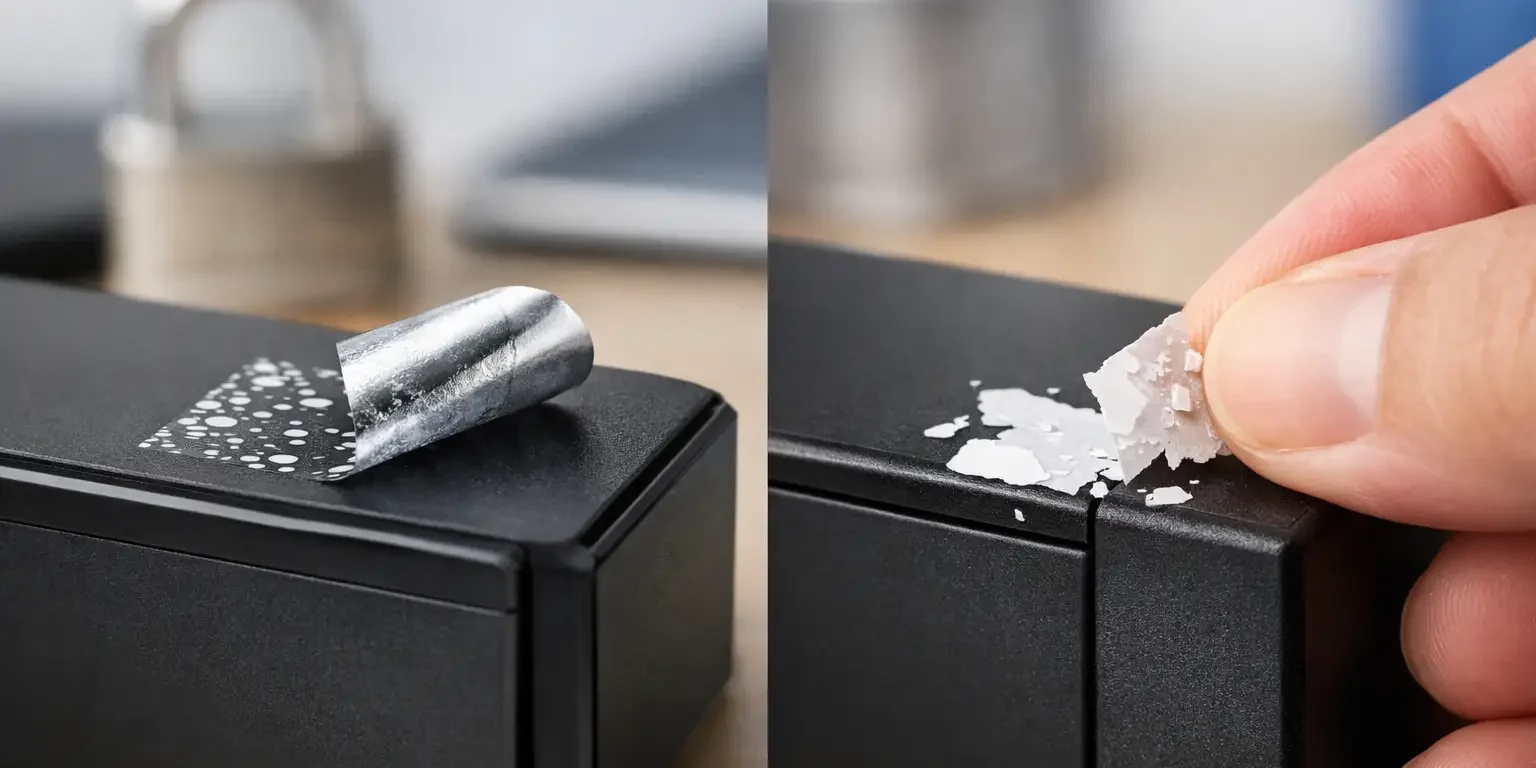
Void labels are designed to leave a visible message when they are lifted. Once applied, the label appears intact. If someone attempts to peel it away, a word or pattern such as “VOID”, a chequerboard or a custom security message is revealed on the surface, the label, or both.
This makes the attempted removal unmistakable. A resealed carton may look presentable from a distance, but the void residue tells the next person that the original seal has been broken. It is a particularly useful result for goods that may pass through several hands before reaching the end user, including pharmaceutical packs, spirits, consumer electronics and high-value retail items.
The main advantage is clarity. The label gives a deliberate, readable signal rather than simply looking damaged. It can also support investigations: a warehouse or returns team can identify a broken seal quickly without opening every item or relying on a subjective judgement about whether a label looks slightly scuffed.
Void materials are available in different constructions. Some leave adhesive residue on the pack, while others transfer a message without a sticky residue. This detail matters. Residue can be helpful where permanent evidence is needed, but it may be unsuitable for a reusable case, a polished product surface or an application where presentation after opening matters.
Where void labels work best
Void labels suit smooth, clean surfaces with enough area for the message to be visible. Folding cartons, plastic cases, metal enclosures, appliance doors and shipping boxes are common examples. They are also a strong option where authorised opening is expected, but you need an immediate record that it has happened.
They are not always the best choice for rough cardboard, heavily textured plastics, oily surfaces or highly curved containers. Adhesion and message transfer must be tested on the actual substrate. A material that performs perfectly on a coated carton can behave differently on recycled board or powder-coated metal.
How destructible seals create tamper evidence
Destructible seals work by breaking apart when removal is attempted. Rather than lifting in one piece, the label fragments into tiny pieces or tears unpredictably. It cannot be removed neatly and reapplied elsewhere.
This creates a different kind of security signal. Instead of revealing a printed void message, the seal itself is visibly destroyed. The effect is highly effective for applications where the label needs to stay permanently attached and any attempt at removal should leave a clear physical mess.
Destructible materials are commonly used on warranty seals, equipment housings, calibration points, electrical cabinets and components where unauthorised access could affect safety, performance or liability. They are also useful for products where a counterfeit operator may try to move a genuine-looking label from one item to another. If the seal falls apart during removal, that opportunity is greatly reduced.
The trade-off is that the resulting evidence can be less uniform than a void message. A broken seal is generally obvious, but the degree of break-up can vary with the surface, adhesive bond and the way it is removed. That is why it is sensible to test samples under realistic conditions before committing to a production run.
Where destructible seals work best
A destructible seal is often the better option when a label is applied directly to a product or hard component and should never be removed intact. It performs especially well on smooth, non-porous surfaces such as metal, glass and many rigid plastics.
It may be less appropriate if customers must remove the label as part of normal use, or if loose fragments would be unwelcome. For example, a consumer-facing package may benefit from the clean visual communication of a void label, while a service-only access panel may benefit from an aggressively fragmenting warranty seal.
Void labels versus destructible seals: the practical differences
The simplest distinction is this: void labels reveal a message after an attempted lift, while destructible seals physically break apart. Both discourage tampering. The better choice depends on the evidence you need people to see and the environment in which they will see it.
Choose a void label when a visible warning message is valuable. This is particularly useful where staff need to make quick decisions during dispatch, returns processing or stock checks. A custom message can also reinforce your brand’s security procedure, such as “Security Seal Broken” or “Do Not Accept If Opened”.
Choose a destructible seal when preventing label transfer is the priority. Its inability to peel away cleanly is a strong deterrent for warranty fraud and interference with equipment. On a small component, it can provide tamper evidence without requiring a large printed message area.
Cost should be considered in context rather than in isolation. The unit price of a label matters, but so does the cost of a disputed return, a counterfeit claim, a compromised product or a service call caused by unauthorised access. A well-specified seal can protect margins and customer confidence far beyond its purchase cost.
Security features that make either option harder to copy
Tamper evidence is only one layer of product protection. A label that tears or reveals VOID makes interference visible, but it may not on its own prove authenticity. Where counterfeiting is a serious concern, combining tamper-evident material with holographic and covert features creates a more credible barrier.
A bespoke hologram can incorporate your logo, distinctive artwork and custom patterns that are difficult to reproduce accurately. Additional features such as UV-reactive details, hidden text or images, thermo-reactive elements, coin-reactive effects and scratch-off panels can give distributors, retailers and trained teams several ways to check a product.
The right combination should reflect the risk. A straightforward branded void label may be enough for low-risk retail packaging. A higher-value product distributed through multiple channels may warrant a holographic destructible seal with a covert verification feature. There is no benefit in adding complexity that nobody can check, but there is real value in security that is easy for the right person to verify and difficult for a counterfeiter to imitate.
Questions to ask before specifying a seal
Start with the surface. Is it cardboard, glass, metal, plastic or a painted finish? Is it flat, curved, textured, cold, dusty or exposed to moisture? The adhesive and face material need to match real operating conditions, not just an ideal sample in an office.
Next, decide what an authorised opening should look like. If the pack will be opened by a retailer or consumer, would a visible VOID message offer reassurance? If only approved engineers should access the item, would a seal that disintegrates provide stronger control?
Think about who must inspect the evidence. A customer needs something obvious and simple. A field engineer may be able to check a smaller, more technical label. Supply-chain teams may require a clear visual cue at speed, while brand-protection teams may need covert features to investigate suspect goods.
Finally, consider design from the outset. A security label can still support premium packaging. The size, holographic finish, colour and placement can be developed around your product rather than treated as an afterthought. HologramLabel.co.uk can help turn a security requirement into a bespoke label specification without making the process needlessly technical.
A sample trial on your actual packaging is often the most useful next step. It shows how the seal adheres, how it behaves when disturbed and whether the evidence is clear to the people who need to trust it. Get that decision right, and every sealed product carries a quiet but convincing message: this item has not been interfered with.