A counterfeit brake pad does not need to look convincing for long. It only needs to pass through a distributor, fit a vehicle and avoid questions until the consequences belong to somebody else. That is why an automotive parts authentication example should begin with the real risk: protecting drivers, workshops and a manufacturer’s reputation at the point where a part changes hands.
For many automotive businesses, the answer is not a single high-tech feature. It is a clear, practical security label system that makes genuine products easy to recognise, makes interference visible and gives counterfeiters a much harder product to copy.
An automotive parts authentication example in practice
Imagine a UK manufacturer of premium replacement brake discs and pads. Its parts are sold through approved motor factors, online retailers and workshop networks. The cartons are professionally branded, but the company starts receiving reports of suspiciously cheap products appearing on online marketplaces. Some packaging looks close to genuine. The parts inside are not.
The manufacturer introduces a bespoke holographic security seal across the opening flap of every brake-pad carton. The seal carries a repeating version of its logo within the holographic image, a distinctive colour-shifting pattern and a small area of hidden text that can be checked with the right viewing method. If a carton is opened, the label breaks apart and leaves a visible void message on the pack.
A technician receiving stock can make a first check in seconds. The hologram should show the correct visual movement and branding. The seal should be intact, correctly positioned and free from signs that it has been lifted or replaced. A distributor carrying out a deeper goods-in check can inspect the covert feature against an approved reference sample.
That is a useful automotive parts authentication example because it addresses three separate weaknesses. It gives genuine packaging a recognisable feature, shows whether the pack has been opened and creates a check that is difficult to reproduce with ordinary printing. The label is not decoration. It becomes part of the product-security process.
Why brake components need more than printed packaging
Standard cartons, printed barcodes and product photographs all have a role, but they are easy to copy. A counterfeiter may reproduce a logo, part number and basic carton artwork well enough to mislead a busy buyer. If the packaging has no physical security feature, the recipient has little to assess beyond appearance.
This applies across the sector. Filters, bearings, sensors, airbags, lighting components, lubricants and electrical parts can all be targets. The pressure varies by product type. A high-value turbocharger may be diverted, substituted or copied because the financial return is obvious. Low-cost safety-critical consumables can be counterfeited at scale because buyers may not inspect every pack closely.
The consequences extend beyond lost sales. A failed component can lead to warranty claims, workshop disputes, safety concerns and costly investigations. Even where the counterfeit has no connection to the genuine manufacturer, the brand on the box may receive the blame.
Build the label around the point of inspection
The best security label depends on who needs to check it and where. A workshop needs a fast visual signal. A warehouse team may need a repeatable receiving procedure. Brand-protection staff may require a covert feature that supports a more confident investigation.
For the brake-pad example, the overt holographic effect is the first layer. It is immediately visible without tools and allows distributors and installers to spot obvious packaging inconsistencies. A custom logo or recognisable pattern makes the label specific to the brand, rather than a generic hologram that could appear on any product.
The second layer is tamper evidence. A destructible material, void label or honeycomb construction can reveal that the carton has been opened. This matters where genuine packaging may be reused to hold an inferior part, or where a product could be exchanged during distribution. The correct material depends on the carton surface, handling conditions and whether a visible residue is suitable for the pack.
The third layer is a discreet authentication feature. UV details, microtext, hidden images or thermo-reactive elements can support trained distributors and internal teams. These are not intended to turn every garage into a forensic laboratory. Their value is that they give the manufacturer a controlled way to distinguish a genuine security label from a superficial imitation.
Make copying expensive, not checking difficult
A security programme fails if it burdens legitimate buyers more than counterfeiters. An installer should not need an app, specialist equipment or a lengthy training session to establish basic confidence in a replacement part. Equally, relying only on a feature visible to everyone gives counterfeiters a clear target to imitate.
Layered protection is the sensible middle ground. The visible hologram reassures at a glance. Tamper evidence protects package integrity. One or more covert details provide a deeper check when something looks wrong. Each layer has a different job, which makes the overall approach more credible than trying to make one feature do everything.
It also helps to issue a simple verification guide to authorised distributors. Show the approved position of the seal, the expected holographic effect and the response process for a suspect item. Keep the guide focused. Buyers need to know what to look for, who to contact and what not to do, such as fitting a questionable safety component while they wait for an answer.
Where serialisation fits – and where it does not
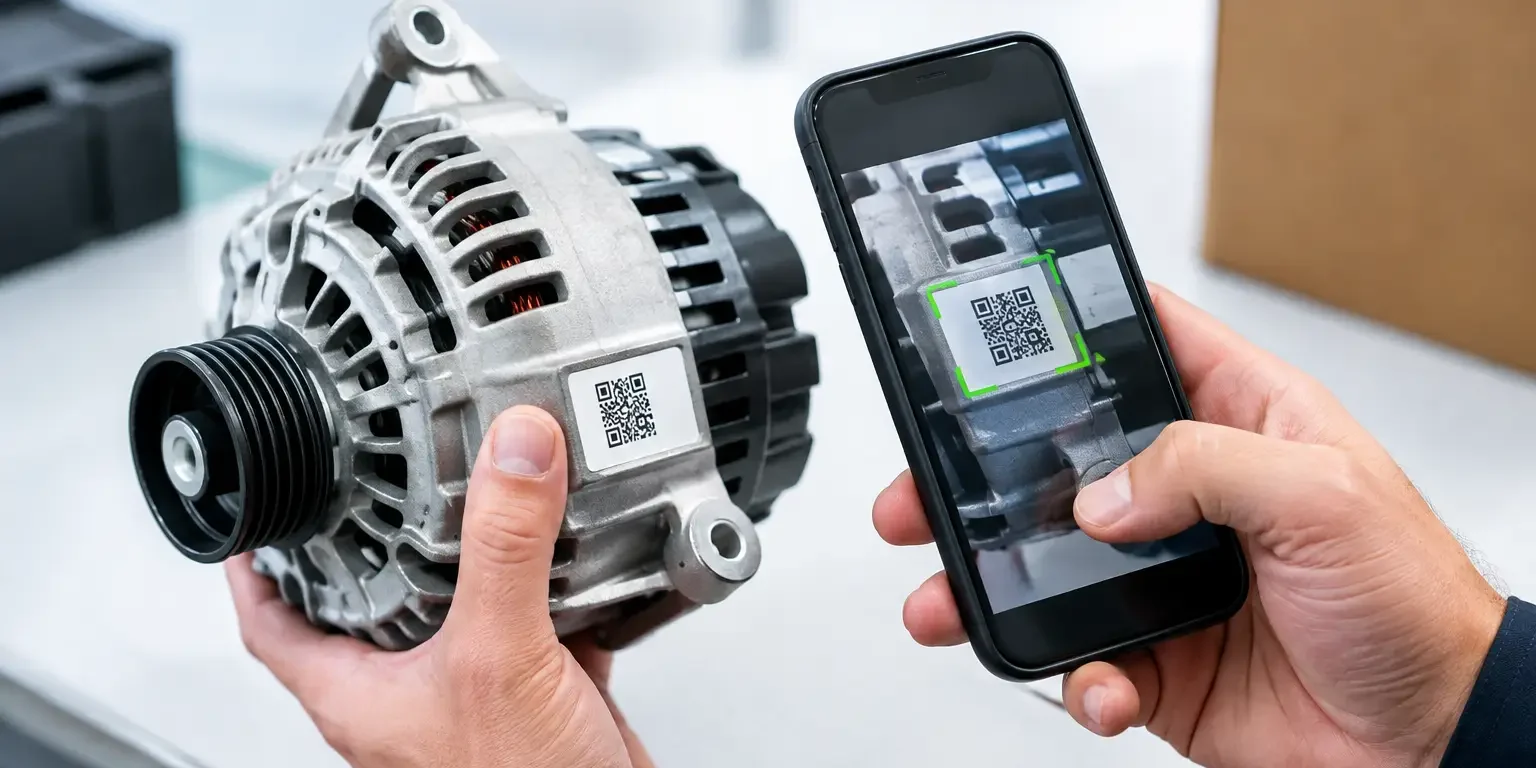
Some automotive brands need individual item traceability, especially for high-value parts, warranty control or tightly managed distribution. Variable serial numbers, QR codes or barcodes can help identify a production batch, route a product through a supply chain or support a database check.
However, serialisation alone is not authentication. A copied carton can carry a copied code. A code can be photographed, duplicated or placed on a substitute product. It is strongest when combined with a physical security label that is difficult to remove and reuse.
For businesses that need variable data, serial numbers, asset labels or custom text, these elements should be planned alongside the holographic seal rather than treated as an afterthought. The physical label needs to fit the packaging design, the intended scan point and the operational process. This is where a specialist label supplier and the right variable-data partner can keep the specification practical.
Specify for the part, pack and supply chain
There is no single label construction that suits every automotive application. A hologram on an oil bottle faces different conditions from a seal on a brake-disc carton. Grease, moisture, abrasion, uneven surfaces, cold storage and heat can all affect how a label performs.
Start by considering the packaging material and the desired evidence of opening. A paperboard carton may suit a destructible label that tears when lifted. A plastic container may need an adhesive and material chosen for that surface. A label bridging a lid or flap must be positioned so that opening the pack physically breaks the seal rather than allowing it to peel away intact.
Order volume matters too. A growing aftermarket brand may need low minimum quantities while it tests a new packaging system or launches a limited product line. A larger manufacturer may need consistent artwork and supply arrangements across multiple product families. Both need clear pricing, realistic lead times and a design process that does not force their team to become security-printing experts.
Treat suspect-product reports as useful intelligence
Authentication labels work best when they feed a wider response plan. Ask distributors, retailers and workshops to retain suspicious packaging where safe and appropriate. Photograph the label, record where the item was obtained and compare it with a known genuine sample. Patterns can reveal a particular sales channel, part family or counterfeit packaging run.
Do not overclaim what a label can achieve. A security seal cannot guarantee that every item in the market is genuine, and it will not replace supplier controls, authorised distribution agreements or investigation work. What it does provide is visible evidence, a stronger barrier to package substitution and a practical trigger for action when a product is questioned.
For automotive manufacturers, that combination can protect far more than a carton. A thoughtfully designed holographic seal gives good distributors confidence, helps workshops pause before fitting a suspect part and tells counterfeiters that your packaging is not an easy opportunity. Bring the product, packaging and supply-chain challenge to HologramLabel.co.uk, and the right mix of visible, covert and tamper-evident features can be designed around it.