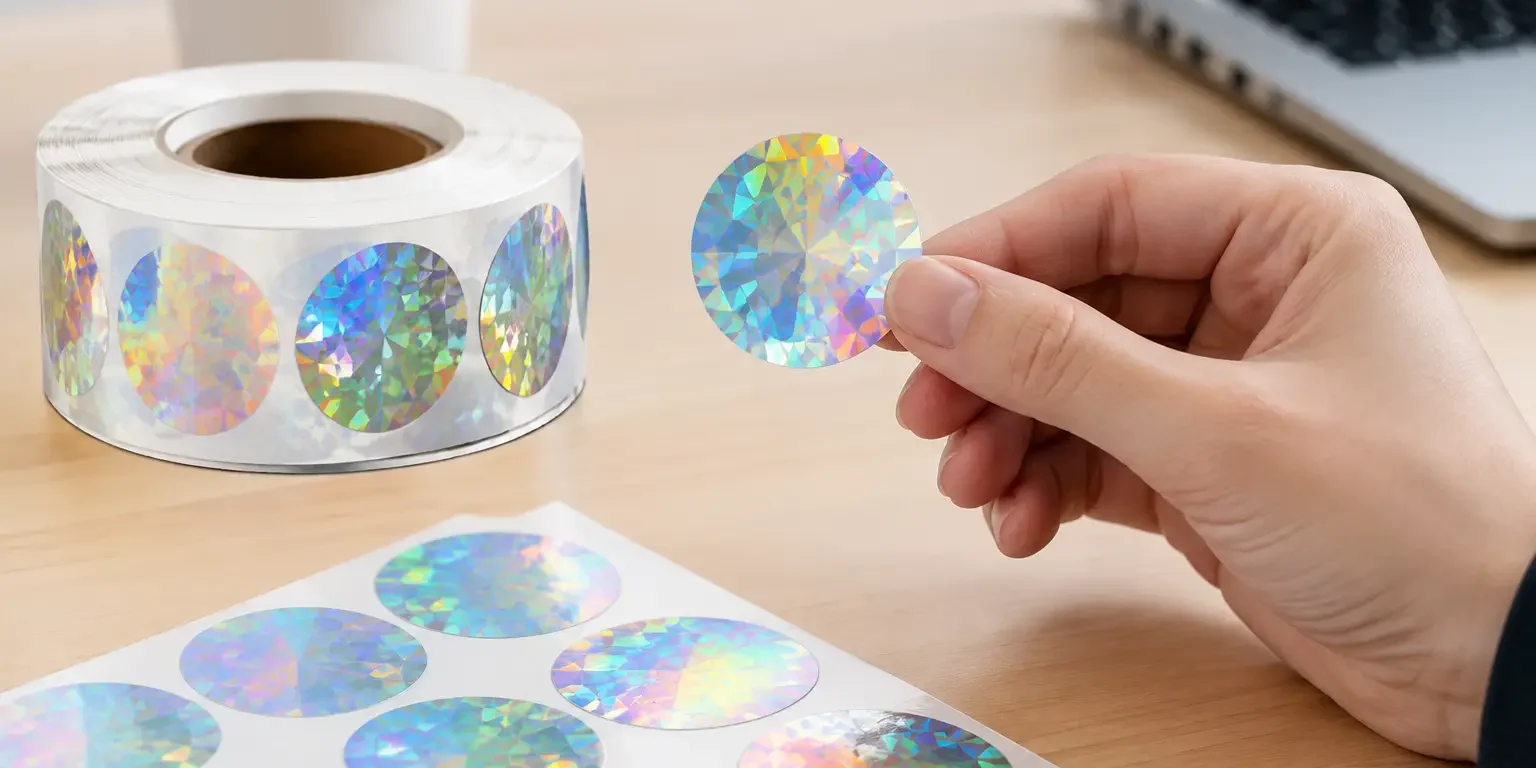
A low minimum order can make the difference between protecting a new product line now and leaving it exposed until the next major production run. This hologram label minimum order guide explains what affects bespoke order quantities, where the real costs sit and how to choose a quantity that works commercially without compromising security.
For UK manufacturers, brand owners and procurement teams, the question is rarely just, “What is the minimum?” It is also whether the label will deter counterfeiting, show interference clearly and fit the packaging process without creating unnecessary stock or waste.
Why minimum orders vary for hologram labels
There is no single sensible minimum order for every hologram label. A ready-to-buy stock hologram sticker can be supplied in relatively small quantities because its design and production setup already exist. A bespoke security label needs artwork, a holographic master design and, where required, specialist materials or security features. Those early stages affect the most economical quantity.
The good news is that custom holograms do not need to be reserved for the largest manufacturers. Low order thresholds make them practical for growing brands, short production runs, premium products and trials before a wider rollout. But low quantity does not mean every complex option costs the same. A simple logo hologram and a multi-layer authentication seal have different production requirements.
Rather than treating the minimum as a fixed number, think of it as the point at which a label can be made properly, consistently and at honest value. That approach protects both your budget and your brand.
Start with the purpose, not the quantity
The strongest specification begins with the risk you need to manage. A cosmetic brand concerned about imitation products needs a different label from an electronics distributor trying to identify warranty tampering. An alcohol producer may want an attractive premium seal that also makes bottle opening obvious. A parts manufacturer may need a label that remains intact through handling, heat and contact with oils.
Set out what the hologram must do before asking for a number of labels. Usually, it will need to deliver one or more of three benefits: visible authentication, tamper evidence or a covert check for authorised staff. The more clearly these priorities are defined, the easier it is to balance the quantity, material and security level.
A visible diffraction effect, your logo and branded pattern make a product easier to recognise at first glance. Hidden text, UV features or concealed images add a second level of inspection that counterfeiters cannot easily copy. Tamper-evident materials such as void, destructible or honeycomb constructions leave a clear sign when a seal has been removed.
Not every product needs every feature. Adding layers can be a wise investment for high-value, regulated or frequently copied goods, but it may be unnecessary for a short-run promotional item. The right label is the one that addresses a real risk, not the one with the longest feature list.
What drives the cost of a small bespoke order?
For custom work, setup has a greater influence on a small run than it does on a large one. That is why the price per label normally falls as quantities increase. The design work and holographic production preparation are spread across more labels.
Size and shape also matter. A compact round seal uses less material than a large label for an appliance carton, while unusual shapes may introduce additional finishing considerations. Material choice is equally significant. A paper label may suit internal presentation, but security applications often call for a more durable construction or a tamper-evident film.
The number of design elements can affect the process too. A clean logo, repeated pattern and clear wording are often enough to create a distinctive custom label. Adding colour, hidden features, thermo-reactive elements, coin-reactive devices or scratch-off areas can provide valuable protection, but should be chosen for a reason.
Finally, consider how the labels will be supplied. Rolls are often efficient for machine application, while sheets may be better for hand application or smaller packing operations. The application method should be agreed early, because it influences the most practical format and may affect the quantity you order.
Choosing a quantity that makes commercial sense
A minimum order is useful when you are validating a design, launching into a new market or protecting a limited edition. It lets you assess application, packaging appearance and customer response before committing to more stock. For a new product, this can be the most sensible route.
For an established range with reliable sales, ordering closer to forecast demand may lower the per-label price and reduce the chance of inconsistent batches later. However, buying far more than you can use is not automatically a saving. Packaging may change, branding may be refreshed and product variants may be discontinued. Security labels should support agility as well as protection.
A practical calculation starts with your expected usage over a sensible period, then allows for application losses, quality checks and a small contingency. If you package 5,000 units each month, ordering exactly 5,000 labels leaves no room for rejects or rework. If the product has several pack sizes, calculate each version separately rather than assuming one label will suit every item.
Where demand is uncertain, ask for a quantity that covers the initial launch and establish the lead time for repeat orders. This gives operations teams a realistic replenishment plan without tying up cash in excessive inventory.
Questions to settle before requesting a quotation
A good quotation should be based on a usable brief, not guesswork. You do not need to understand every production detail – that is our job – but a few decisions will make the process faster and clearer.
Be ready to confirm the label dimensions, shape, intended surface and whether the label will be applied by hand or machine. Describe the environment as well. Labels for a clean retail carton face different conditions from seals used on automotive components, refrigerated packaging or products stored in warehouses.
It also helps to provide your logo and brand artwork in the best available format, along with any wording that must appear on the label. If tamper evidence is essential, say how you want the label to behave after removal. A void message can reveal that a seal has been lifted, while a destructible material breaks apart and cannot be reapplied as one piece.
If you require serial numbers, barcodes, asset identification or changing text from one label to the next, raise this at the beginning. Variable information is a different requirement from a standard bespoke hologram run and should be planned through the appropriate production route.
Avoid the false economy of an under-specified label
The cheapest label is not always the lowest-cost decision. A label that peels away cleanly, cannot survive its intended environment or provides only decorative shine may leave your product open to diversion and substitution. The cost of one counterfeit claim, returned consignment or damaged customer relationship can outweigh the difference between a basic sticker and a considered security seal.
That does not mean every order needs the most advanced protection available. The sensible approach is proportional. Products with high resale value, safety implications or a history of copying justify stronger, layered features. Lower-risk items may need a recognisable branded hologram and simple tamper evidence. Clear priorities lead to clear pricing, with no catches and no unnecessary complexity.
Plan for repeatability from the first run
Once a design is approved, keep a record of the agreed specification: dimensions, material, adhesive, finish, security devices, artwork version and application format. This makes repeat ordering more reliable, particularly when different teams handle purchasing, packaging and quality control.
It is also worth retaining a controlled sample as a reference. Staff receiving labels or checking finished products should know what genuine labels look like, how the holographic effect behaves and what tamper evidence appears after removal. Security works best when the people handling the product know what they are looking for.
A specialist supplier can turn an ambitious concept into a practical label specification, whether you need a small first run or a programme that supports ongoing production. Bring the product, the risk and the quantity you expect to use – then build the security label around what your business genuinely needs.