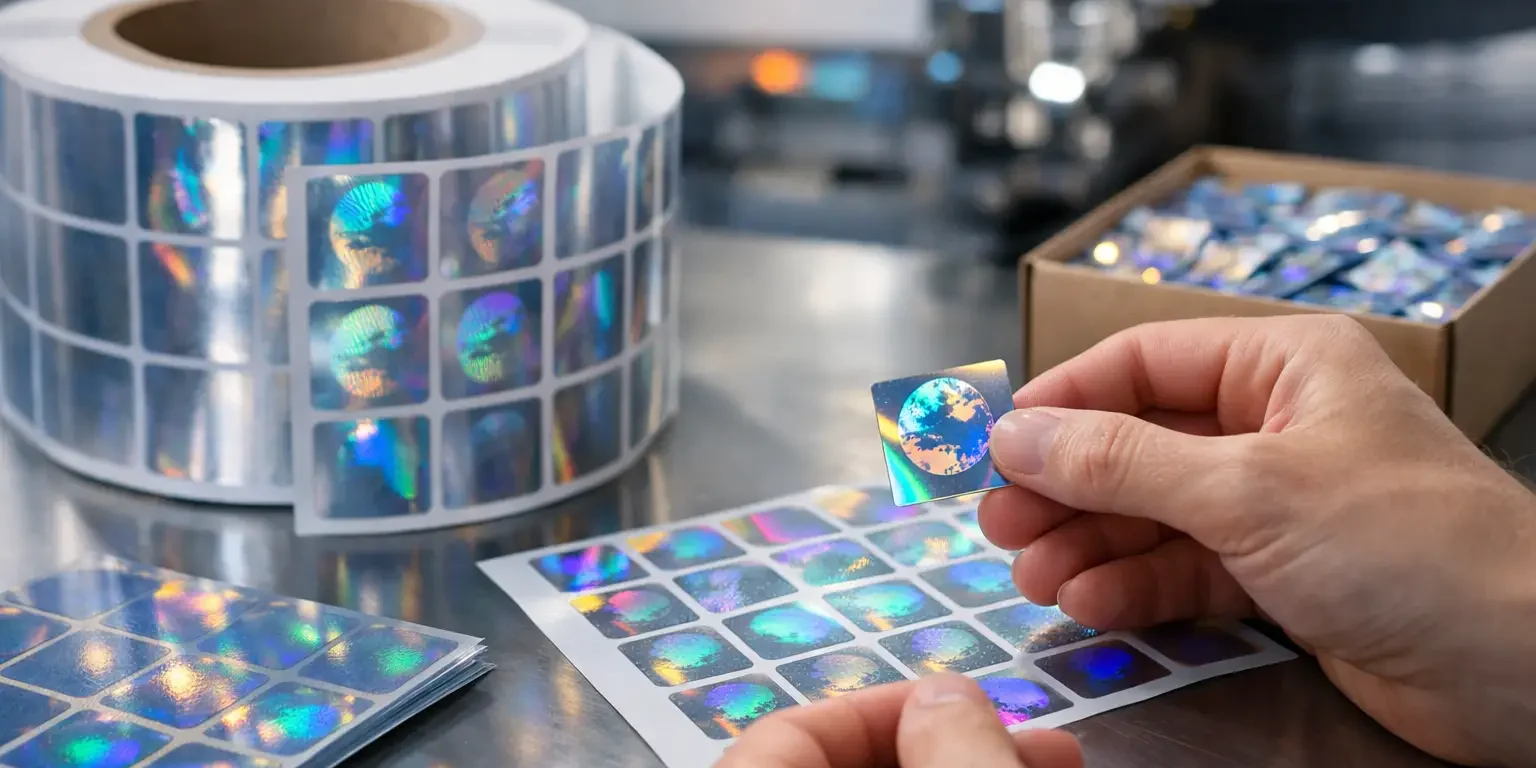
A counterfeit does not need to look perfect to cause damage. It only needs to look convincing enough to pass through a distributor, appear on a marketplace or disappoint a customer who believes it came from you. Low minimum order holograms give growing brands and established product owners a practical way to add visible authenticity and tamper evidence without committing to an oversized print run.
For many businesses, security labels have traditionally felt like something reserved for high-volume manufacturers. Large minimum quantities, complicated specifications and long lead times can put bespoke protection out of reach, particularly when a product is new, seasonal or sold in several smaller ranges. That does not need to be the case. A carefully designed hologram label can make a product harder to copy, easier to identify and more professional on the shelf, even when your initial requirement is modest.
Why low minimum order holograms matter
The right quantity is not always the largest quantity. If you are launching a cosmetics line, trialling a premium spirits product, supplying specialist automotive parts or producing limited-edition collectibles, ordering more labels than you can use ties up cash and creates unnecessary storage. It can also leave you with obsolete stock when packaging artwork, legal information or product positioning changes.
Low minimum order holograms allow you to begin with what your business genuinely needs. You can test placement, assess how the label performs through packing and distribution, and gather feedback from retailers or customers before scaling up. This is especially useful when the hologram forms part of a wider packaging refresh rather than being added to an established product.
There is a security benefit too. Smaller, more controlled batches can make stock management simpler. Your team can monitor where labels are applied, reconcile quantities against production runs and reduce the risk of unused labels being left unsecured. A hologram is one part of a brand-protection plan, but good control over label stock makes that protection more meaningful.
What a hologram label can do for your product
A quality hologram has immediate visual value. Its shifting light effects are difficult to reproduce with ordinary printing, giving genuine products a recognisable feature that customers, retailers and internal teams can check quickly. It signals that the packaging has been considered, which can be valuable for premium products as well as security-sensitive ones.
The stronger option is to combine that visible effect with tamper evidence. A label applied across a carton flap, bottle cap, electronics enclosure or product closure can show whether the pack has been opened. Depending on the material selected, it may break apart on removal, leave a void message behind or reveal a honeycomb pattern. This helps businesses identify interference before a product reaches the end user.
For higher-risk applications, the hologram design can also include security details that are not obvious at first glance. Hidden text, concealed images, UV-reactive features, thermo-reactive elements and coin-reactive effects provide additional ways to check authenticity. The best combination depends on who needs to verify the label. A consumer needs a simple visible cue; a warehouse team may use a torch or a written check process; an investigator may require a covert feature that counterfeiters are less likely to notice.
Choosing the right level of protection
Not every product needs every available security device. Adding features simply because they sound advanced can increase cost without making verification easier. The starting point should be the risk your business faces and the consequence of a product being copied or interfered with.
A low-value retail item may benefit most from a branded holographic seal with a clear tamper-evident function. The aim is to discourage casual substitution, reinforce authenticity and make opened packaging apparent. By contrast, pharmaceutical products, high-value electronics, vehicle components and regulated goods may require multiple layers: a custom holographic pattern, a destructible material and one or more covert checks.
Think about the product surface as well. Labels behave differently on curved bottles, textured cartons, oily components, flexible pouches and outdoor equipment. The label must stay attached in the conditions it will face, yet show clear evidence if someone tries to remove it. This is why the material and adhesive deserve as much attention as the holographic artwork.
Bespoke design makes copying harder
Generic hologram stickers can improve presentation, but they provide limited protection if anybody can buy the same design. A bespoke hologram that incorporates your logo, brand name, repeat pattern or specific imagery gives customers a recognisable reference point and makes direct imitation more difficult.
The design does not need to be overly busy. In fact, a clean, well-planned hologram is often easier to authenticate. A distinctive logo, carefully positioned hidden text and a pattern that cannot be mistaken for a standard stock design may be more useful than a crowded collection of effects. Your label should support your brand identity while providing a practical check for genuine goods.
Colour can also play a role. Holographic foil catches the light naturally, while selected printed colours can connect the seal to the rest of your packaging. The objective is a label that looks intentional, not an afterthought applied at the end of the line.
What to prepare before requesting a quote
A bespoke order becomes straightforward when the essential information is clear. You do not need to arrive with a technical specification – that is our job – but a few practical details will help shape the right solution.
Start with the label size and the surface where it will be applied. Consider whether it needs to seal a closure, sit on a flat carton, wrap around an edge or fit within a limited space. Then identify the likely quantity for the first run and whether repeat orders are expected. It is also helpful to explain the product type, any known counterfeiting or tampering concerns, and whether the label will be applied by hand or through an automated process.
Finally, decide who needs to authenticate it. If consumers are expected to check the label, the visible design should be clear and easy to describe. If checks are carried out internally, a discreet feature may be appropriate. Where each label needs a unique serial number, barcode, asset reference or changing text, a specialist variable-data label solution may be required alongside the hologram.
When low quantities are the sensible commercial choice
A lower minimum order is not only for start-ups. It is often the sensible option for businesses managing multiple SKUs, regional packaging, promotional editions or products with frequent artwork updates. A manufacturer may need different seals for separate product lines. A distributor may need a short run while assessing a new supplier. A premium brand may want a limited seasonal design that will not be used again next year.
The trade-off is simple: higher quantities can reduce the unit price, while smaller orders reduce upfront spend, storage needs and the chance of waste. The best value is therefore not always the lowest price per label. It is the order size that matches your sales forecast, packaging cycle and security requirements.
At HologramLabel.co.uk, the focus is on making bespoke holographic protection accessible without diluting the quality of the finished label. That means discussing what you are trying to protect, rather than pushing a one-size-fits-all security feature.
Make the label part of your process
A hologram works best when it is supported by clear handling procedures. Keep unused labels secure, record quantities issued to production and train packers on correct placement. Retail and customer-service teams should know what the genuine label looks like and what to do if they see packaging that appears opened or suspicious.
It is also worth documenting the features you have chosen. This need not be a complicated manual. A short internal guide showing the visible design, placement and any authorised verification method gives your team a consistent reference. If a concern arises, you can respond with confidence rather than relying on memory.
Low minimum order holograms let you take a proportionate first step: protect the products you have now, learn what works in the real world and build on that protection as your brand grows.