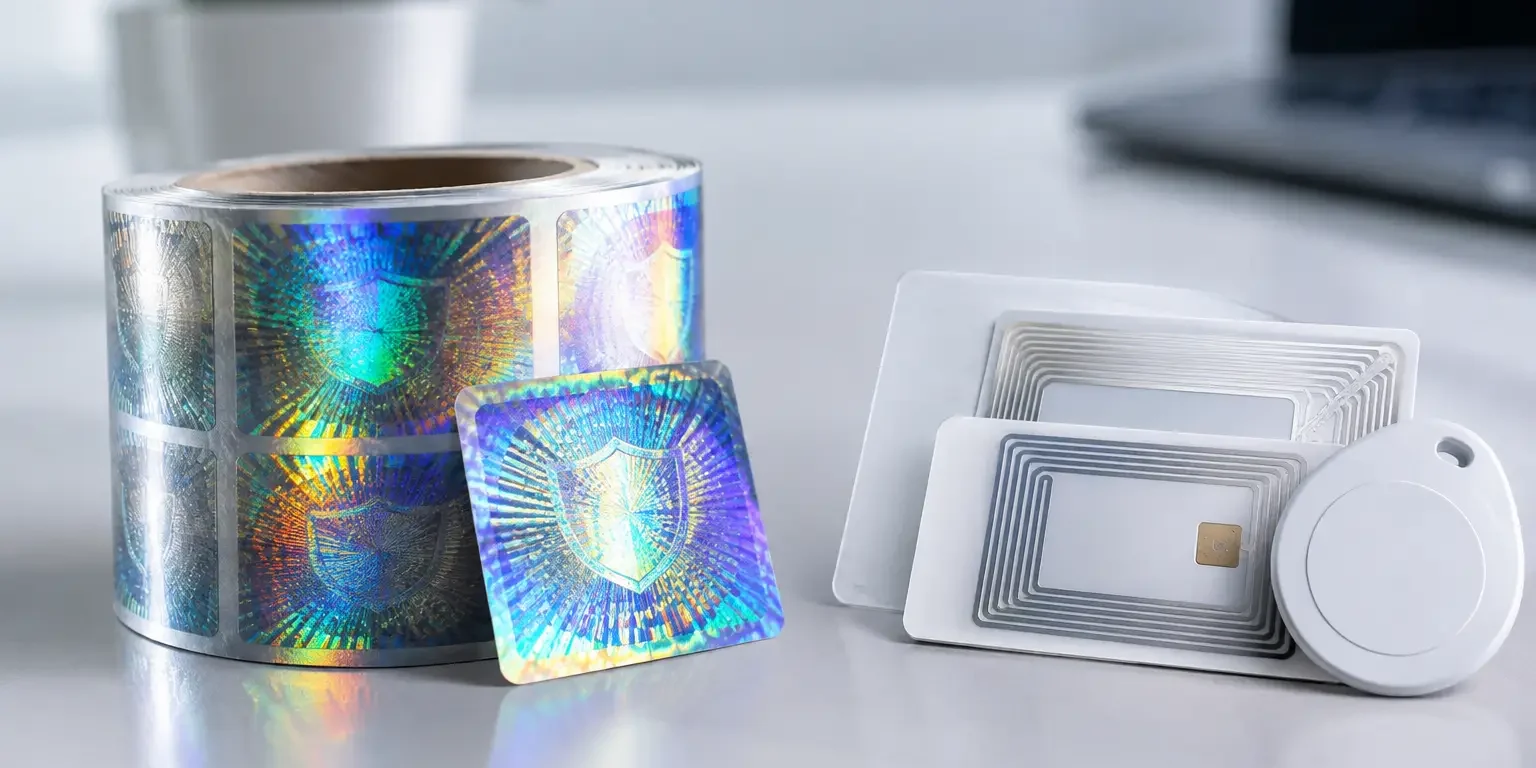
A counterfeit bottle of cosmetics may look convincing on a shop shelf, yet fail a simple inspection at the point where its seal should break. A diverted electronics unit may look genuine too, but reveal the wrong serial history when scanned at a warehouse. That is the practical difference behind security holograms versus RFID tags: one gives people a visible, physical way to inspect a product; the other gives systems a digital way to identify and track it.
Neither is automatically the better choice. The right protection depends on what you need to prove, where checks take place, how much handling a product receives, and whether your staff, distributors or customers need to verify authenticity without specialist equipment.
What security holograms do well
A security hologram is a label or seal that uses a distinctive holographic image, pattern or effect to make copying more difficult and authentication easier. On a well-designed bespoke label, the holographic effect is only one layer of protection. It can sit alongside a company logo, fine-detail artwork, hidden text, UV-reactive features, colour-changing elements or covert images known only to authorised inspectors.
For many product owners, the immediate advantage is visibility. A customer, retailer or delivery team can see that a label is present and assess whether it appears correct. No reader, software account or network connection is needed. That matters when products move through varied retail channels, are exported, or are checked by people who may only have a few seconds to make a decision.
Holograms are also particularly useful when package integrity is as important as product identity. A destructible hologram seal, void label or honeycomb tamper-evident material can show clear evidence if somebody has opened, substituted or interfered with packaging. Once removed, the label breaks apart or leaves a visible message behind. It does not merely say, “this item has an identity”; it helps answer, “has this pack been opened since it left us?”
That physical signal is valuable for pharmaceuticals, cosmetics, alcohol, electronics, automotive parts and higher-value retail goods. It can also give a brand a more premium, considered finish without treating security as an unattractive afterthought.
The limits of a hologram-only approach
A hologram is not a magic barrier. Cheap generic holographic stickers are readily available, and a counterfeiter may try to imitate the look of a label from a distance. The defence lies in bespoke design, controlled production and layered security features that are difficult to reproduce accurately.
A hologram also does not create an automatic digital record of every item’s movement. If you need to know which individual unit was packed, shipped, received, returned or recalled, a standard non-serialised label cannot provide that information on its own. For that requirement, variable data or a digital identification technology may be needed alongside the visible seal.
What RFID tags do well
RFID stands for radio-frequency identification. An RFID tag contains a small chip and antenna that can be read by compatible equipment without a direct line of sight. Depending on the tag type and the system behind it, it may hold a unique identifier and connect to records covering an item’s location, status or movement through the supply chain.
Its strength is operational visibility. A warehouse can scan a group of tagged items far faster than checking them one by one. A distributor can compare an incoming shipment against an expected list. A business with a high volume of reusable assets may use RFID to monitor where equipment has gone and whether it has returned.
For certain applications, RFID can contribute to anti-counterfeiting too. If every product has a unique chip identity and that identity is checked against a controlled database, a copied or unexpected tag can be flagged. More advanced RFID solutions can use security features within the chip to make unauthorised duplication harder.
This makes RFID attractive where traceability is central to the business case: large inventories, closed supply chains, controlled distribution networks, asset management and high-throughput warehouses. The value comes not just from the tag, but from the process around it.
The limits of RFID
An RFID tag does not necessarily provide obvious tamper evidence. A package may be opened and resealed while the chip continues to scan successfully, unless the tag is designed and positioned to break when opened. It is also less useful as a consumer-facing feature if the buyer does not have access to an appropriate reader or app.
Cost and infrastructure deserve honest consideration. RFID requires tags, readers, integration, data management and a process for handling exceptions. Metal, liquids, dense packaging and tag placement can affect read performance. A pilot is sensible before a full roll-out, especially where products are packed tightly or stored in challenging conditions.
There is also a security distinction that is easy to miss: an RFID number alone is not proof of authenticity. If a basic tag can be read, copied and placed on another item, the system may recognise an identifier without recognising the genuine product. The level of protection depends on the chip, the database controls and how reliably each scan is verified.
Security holograms versus RFID tags: the real choice
The comparison becomes clearer when you start with the threat rather than the technology. If your main risk is packaging interference, unauthorised returns or substitution on shelves, a tamper-evident hologram seal is often the more direct and cost-effective answer. It creates a visible deterrent and leaves evidence where people need to see it.
If your main problem is tracking thousands of items through warehouses and distribution points, RFID may be worth the investment. It can reduce manual scanning and strengthen stock control, provided the system is properly deployed and monitored.
For a growing brand selling through retailers, marketplaces and distributors, a bespoke hologram label can be the practical first layer. It is accessible to non-technical users, supports brand recognition and can be applied to packs, cartons or products without changing warehouse systems. Low minimum order quantities also make it realistic to introduce security before a brand reaches enterprise scale.
For a high-value product with complex supply-chain exposure, the strongest answer may be both. An RFID tag can support internal tracking and unit-level records, while a holographic tamper-evident seal provides an immediate visual check at the package. The two technologies address different moments of risk rather than competing for exactly the same job.
Choose based on who must check the product
Think about the person making the check. A consumer standing in a shop can recognise a branded holographic seal and see whether it has been disturbed. A customs officer or field representative can use overt and covert design cues, perhaps supported by a UV lamp, without accessing your internal database.
By contrast, a warehouse operator equipped with fixed readers or handheld scanners can gain considerably more from RFID. Their question is often not simply whether the item looks right, but whether it belongs in this consignment, at this location, at this time.
This is why a security label specification should cover the checking journey. Decide who needs to authenticate the item, what equipment they have, what they should see, and what action they should take when something does not match. A sophisticated feature has limited value if the people responsible for checking cannot use it confidently.
Build layers rather than buying a single feature
Counterfeiters look for the weakest point. A single visible holographic effect may be imitated. A chip that is never checked may offer little practical protection. A well-considered security programme combines deterrence, inspection and response.
A bespoke hologram can carry your logo and distinctive artwork while incorporating hidden text, UV details, scratch-off areas or thermochromic effects. Tamper-evident materials can show that a seal has been lifted. Where individual identifiers, barcodes, serial numbers or asset details are required, these can form part of a wider labelling and data process.
The balance should be commercially sensible. There is no benefit in specifying every available feature if the risk does not justify the cost or if routine checks become too complicated. Start with the product’s value, the likely method of fraud and the places where diversion or interference is most likely. Then select layers that give your team clear evidence and your customers visible reassurance.
A practical route to the right label
Before choosing between holograms and RFID, gather a few facts: the product surface and packaging material, expected application conditions, whether the seal must break on opening, annual volumes, distribution channels and the people who will inspect it. A good supplier can turn those requirements into a label construction that works in real handling conditions, not only on a presentation sample.
HologramLabel.co.uk can help businesses turn an initial security concern into a bespoke hologram label design, without making the specification process needlessly technical. Where variable data, serial numbers or asset-labelling requirements are central, those needs should be considered early too, so the visible and digital elements support each other.
The most useful next step is often to put a genuine pack, a likely counterfeit scenario and an opened-package scenario side by side. When you can see exactly what each person needs to spot, the right combination of protection becomes much easier to specify.