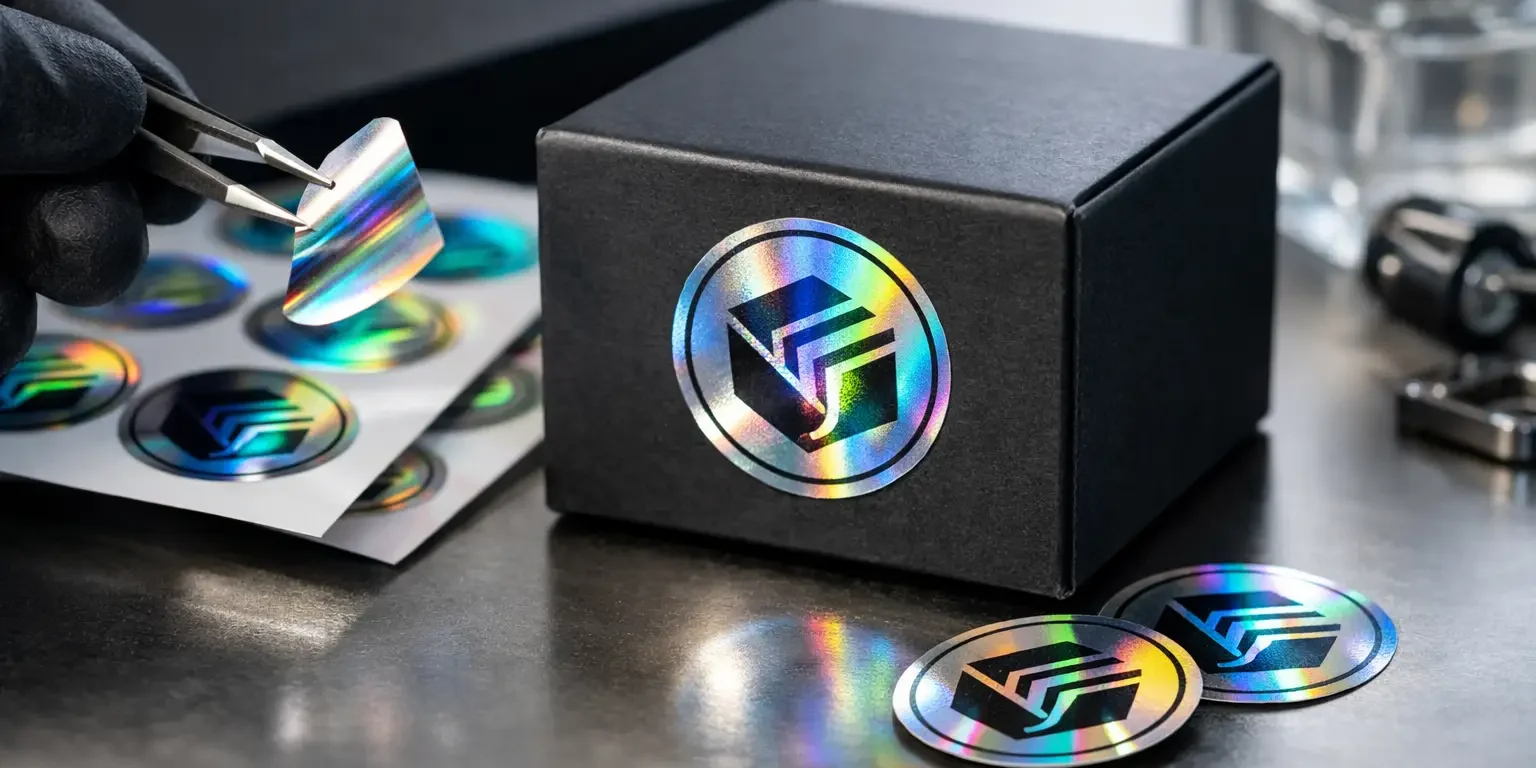
A customer should be able to tell at a glance that the product in their hand is yours – and that nobody has interfered with it on the way. Custom logo hologram stickers give packaging that visible signal of authenticity while adding a practical barrier for counterfeiters, grey-market sellers and anyone attempting to reseal a product.
For UK businesses, the value is rarely just the holographic shine. A well-designed label can carry your logo, brand colours and a recognisable pattern while incorporating tamper evidence and security details that are difficult to copy convincingly. It is a small component with a serious role in protecting revenue, reputation and customer confidence.
Why a branded hologram is more than packaging decoration
Counterfeit goods do not only affect global luxury brands. Electronics, cosmetics, supplements, automotive parts, alcohol, collectibles and industrial components can all be targets where demand is strong and buyers cannot easily judge authenticity before use. Even where there is no deliberate counterfeiting, unauthorised substitution, diverted stock and opened packaging can create expensive problems.
A generic hologram may look official, but it offers limited brand recognition. Custom logo hologram stickers make the security device specific to your business. When the holographic image includes your logo or a bespoke repeated design, a copycat cannot simply buy an off-the-shelf label and achieve the same result.
That distinction matters at several points in the supply chain. Warehouse teams can check stock quickly. Retail staff have a visible cue when receiving goods. Customers get reassurance at the point of purchase. If a product is questioned later, the label gives your team a clear feature to inspect rather than relying on packaging artwork alone.
The label also earns its place visually. Holographic movement catches the eye on a crowded shelf, while a design tailored to your packaging can make a genuine product feel more considered and premium. Security and presentation do not have to compete.
What custom logo hologram stickers can do
The right specification depends on what you need people to check, where the label will be applied and the level of risk involved. For some brands, a clear branded hologram and tamper-evident adhesive are the sensible starting point. For others, several visible and hidden features create a more layered defence.
Make authentic products easier to recognise
A bespoke holographic design can incorporate a company logo, product emblem, wording, geometric pattern or colour effects. These details give your labels a consistent identity that is hard to reproduce using standard print methods. The aim is not to make the label complicated for honest customers. It is to create a recognisable genuine article and a more demanding target for fraudsters.
Overt features are those that a customer, retailer or inspector can see without equipment. They may include holographic depth, shifting imagery, distinctive patterning or visible micro-detail. They are useful when fast checks matter, such as at goods-in, on a retail counter or during a field-service visit.
Show if packaging has been opened
A hologram label can also function as a seal. When placed across a carton flap, cap, closure or access point, it makes unauthorised opening evident. Destructible materials break apart when removed, while void and honeycomb constructions leave an unmistakable message or pattern behind on the product or packaging.
There is a trade-off. The most aggressive tamper-evident materials are excellent where the label must not be removed intact, but they are not right for every surface or every packaging journey. A label applied to rough cardboard behaves differently from one used on smooth glass, coated cartons or moulded plastic. Adhesive choice, label size and placement should be considered before production, not after a problem appears on the line.
Add checks that are not obvious to counterfeiters
Covert security features provide another level of protection. UV-reactive elements can appear under ultraviolet light. Hidden text or images can give trained teams an authentication check without advertising exactly what to look for. Thermo-reactive or coin-reactive details can provide a simple physical test where appropriate, while scratch-off areas can conceal information until it is needed.
Not every product needs every feature. Adding too many devices can increase cost and make internal checking less consistent. A better approach is to decide who will verify the label and under what conditions. A consumer needs a quick visible cue. A distributor may be able to use a UV torch. Your quality team may need a more detailed inspection method. Build the label around those real-world checks.
Choosing the right material and format
The label is only effective if it stays attached and performs throughout the life of the product. Temperature changes, oils, moisture, abrasion and textured surfaces all influence the best material. A cosmetics jar stored in a bathroom, an automotive component exposed to workshop conditions and a premium bottle handled repeatedly each place different demands on an adhesive label.
Size matters too. Small products may only have room for a compact seal, which makes a bold logo and straightforward tamper function more useful than fine detail. Larger cartons, cases and machinery can accommodate a bigger label with additional security features. The right answer is not necessarily the largest or most complex label. It is the one that remains clear, difficult to remove and easy for your intended audience to recognise.
Consider the application process as early as possible. Will labels be applied by hand, on a packing bench, or through an automated line? Is the placement area clean and consistent? Does the seal need to bridge two surfaces? These practical questions affect label shape, release liner, adhesive and tolerances. A design that looks excellent on screen can fail commercially if it slows fulfilment or does not suit the substrate.
Start with the risk, not the finish
The most effective brief begins with the problem you want the sticker to solve. Are counterfeit products reaching online marketplaces? Are returns being fraudulently resealed? Do you need to reassure buyers of a premium item, or help distributors identify approved stock? The answer guides the balance between brand enhancement, tamper evidence and authentication.
It also helps to map the label’s journey. Think about where it is applied, who sees it, whether it faces sunlight or friction, how long products may sit in storage and what should happen if someone tries to peel it away. This gives a specialist label team enough context to recommend a sensible construction rather than simply supplying a shiny sticker.
For a straightforward procurement process, prepare your logo artwork, preferred dimensions, application surface, expected order quantity and any known packaging constraints. If you have a target budget, share that as well. Honest pricing works best when the specification is built around what genuinely protects the product, rather than unnecessary extras.
Low minimum order quantities can make bespoke holograms accessible for growing brands, limited product runs and pilots. They also allow established businesses to test a new seal position or design before committing to a larger rollout. Fast turnaround is valuable, but it should not replace proper checks on artwork, material choice and proof approval.
Avoid the common weak points
A hologram is not a complete anti-counterfeiting strategy on its own. If a label can be lifted cleanly and reapplied, or if no one in the business knows how to check its features, its protective value is reduced. The same is true when all security information is printed openly on packaging for counterfeiters to study.
Keep internal guidance proportionate and practical. Explain to relevant staff what a genuine label should look like, where it should be positioned and what evidence of removal looks like. For layered features, decide who is authorised to carry out deeper checks and make sure they have the appropriate tools. Consistency is often more valuable than an impressive feature that nobody uses.
Where each individual unit needs a unique serial number, barcode, asset identifier or variable text, the hologram specification may need to sit alongside a variable-data labelling solution. Separating these functions can be the most reliable route, particularly when traceability and stock control are as important as visible authentication.
Make the label part of the product promise
Custom hologram labels work best when they feel intentional, not added as an afterthought. Your customers should see a clear sign that you care about genuine goods, unopened packaging and the standard behind your name. Your operations team should have a seal that is practical to apply. And your brand should have protection that reflects the value of what it sells.
At HologramLabel.co.uk, the starting point is your idea, your product and the risks you face. Bring the ambitious concept, the awkward packaging challenge or the simple need for a dependable branded seal. The technical detail is our job – so you can put a stronger mark of authenticity on every product that carries your name.